Background and Basics
Wind flow in the atmosphere is caused by uneven heating surfaces of the earth, large bodies of water, and the rotation of the earth. Wind energy consists of wind turbines converting the wind flow's power moving the propellers into usable energy.
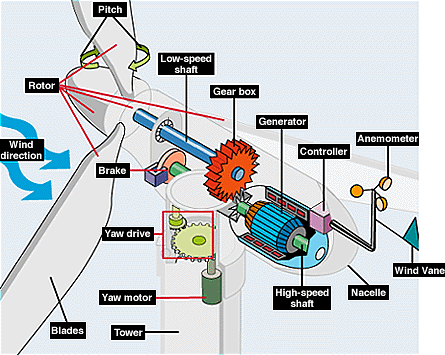
Components:
- □ Nearest to the ground is the mount and the tower. The tower supports the rotor, drivetrain, all of the cables, and anchors the system into the ground.
- □ The drivetrain contains the gearbox and the generator that stores the energy created from the turbine.
- □ The rotor or blades of the windmill converts wind energy into rotational shaft energy. This is why the blades rotate in a clockwise or counterclockwise axis.
Benefits
- □ Houses that live near or at a wind turbine have an increased property value.
- □ The wind power industry has created over 114,000 jobs in the United States.
- □ Overall cost of electricity will decrease.
Thinking about Investing?
- □ Make sure your house is compatible with wind energy usage. Some guidelines include:
- ▫ House is located in a rural area where a lot of wind is present. A relatively constant wind speed of at least 13 mph. Near airports, etc.
- ▫ Where other wind turbines are present.
- ▫ Checking the area of your home with the United States Environmental Protection Agency (EPA) and state laws and regulations.
- □ The general components of a wind turbine for the average house in the United States:
- ▫ 30 to 60 feet in height.
- ▫ 10 meters in diameter.
- □ Households and businesses that use wind energy as their primary source typically install 5-15 kilowatts (kW) of energy into their turbine.
💡 Tip: Reduce your electricity consumption
With or without the installation of your renewable energy system, many measures can be taken to reduce your carbon footprint. You should first eliminate devices and appliances that use too much of Energy. These include standby devices, incandescent light bulbs, and water heaters: the lower your overall consumption, the lower your carbon footprint.
In most cases, lighting is the most significant single cost factor. Obsolete bulbs use only roughly 10% of the power to make light. As heat, 90 percent is lost. It produces heat rather than light, as it is based on a glowing tungsten filament. Modern LEDs use almost all of the electricity to make light. You can notice this from the fact that they stay cool, i.e., there is much less loss. To produce the same amount of light, a good LED requires about a 10th of the electricity. And because it does not heat up so much, it lasts much longer. And: The price of LEDs has come down so much, that exchanging them for regular light bulbs pays off within one or two years.